
Video content has become one of the most effective marketing tools for businesses in the UAE. Professional video editing helps brands create high-quality content that captures attention, builds credibility, and increases customer engagement. From social media campaigns to corporate promotions, well-edited videos make a lasting impression and support business growth in a competitive market.
What Professional Video Editing Actually Does (Beyond Cutting Clips)
Professional video editing is the full post-production process that transforms raw footage into a finished, brand-consistent, platform-ready piece of content.
It includes:
- Color grading: making footage look intentional, not accidental. Matching shots to make the final cut feel cohesive.
- Sound design and audio mixing: cleaning background noise, balancing music and voiceover, adding sound effects where needed.
- Motion graphics and text overlays: animated titles, lower thirds, call-to-action cards, logo animations.
- Pacing and rhythm: cutting to hold attention, using beat-synced edits, removing dead air.
- Subtitles and captions: essential in the UAE, where audiences are multilingual and many watch without sound.
- Export and platform optimization: delivering the right resolution, aspect ratio, and file spec for each platform: 9:16 for Stories/Reels, 16:9 for YouTube, 1:1 for feed posts.
The Real Cost of Skipping It In Revenue, Not Just Aesthetics
Here is where the conversation usually shifts. Business owners often frame professional editing as a “nice to have.” The data says otherwise.
Trust erosion happens at the point of first contact. Wyzowl’s Video Marketing Report consistently finds that over 80% of consumers say video has directly influenced a purchase decision. But that influence only activates when the viewer trusts the brand. Low-quality video actively undermines trust; it signals that a business either doesn’t care enough to invest, or can’t afford to.
In the UAE’s competitive market, both signals are damaging.
Platform algorithms amplify the gap. Instagram, TikTok, and YouTube all reward content that earns watch time and saves. Polished videos hold attention longer. That means the algorithm pushes them to more people organic reach that your competitors are earning and you’re not.
The competitor’s default is now professional. If your five closest competitors all have professional video content and you don’t, you’re not just losing on aesthetics. You are losing at the awareness stage before a single conversation has happened.
Read More: Professional Video Editing Services Dubai That Convert
7 Signs Your Business Videos Need Professional Help
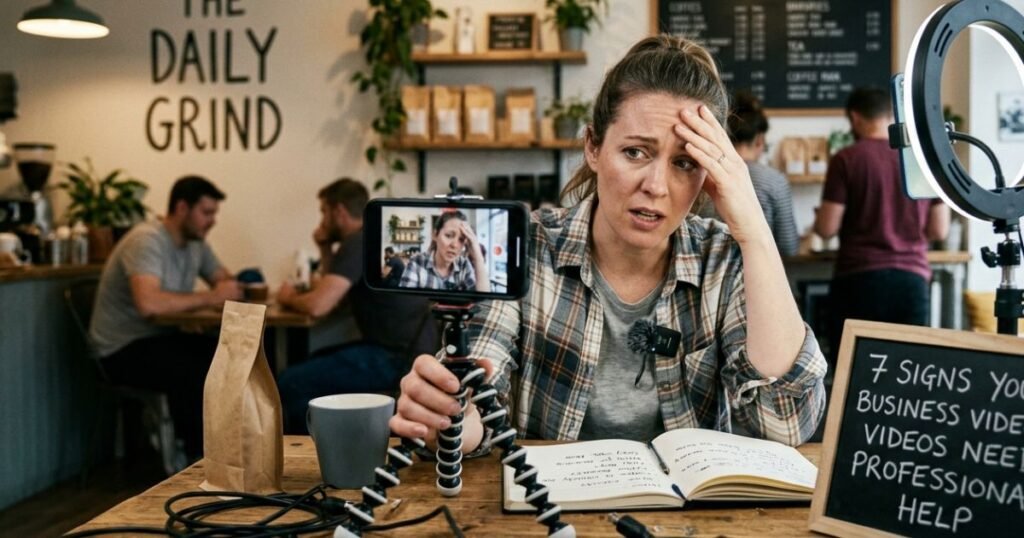
Be honest as you read this list. How many apply to your current content?
- Color shifts between shots: different clips in the same video look like they were filmed on different days (because they were, and nobody corrected for it).
- Background noise underneath dialogue: air conditioning hum, traffic, echo in a room. Viewers can hear it even if they can’t identify it, and it makes your audio feel cheap.
- Your logo isn’t in the video: or it appears once, briefly, in the wrong color, at the wrong size.
- The pacing feels slow or awkward: there’s dead air, long pauses, or cuts that don’t flow. Viewers feel it before they can explain it.
- No subtitles or captions: an estimated 85% of social media videos are watched on mute. If your message requires audio, you’ve already lost most of your audience.
- Wrong aspect ratio: your 16:9 landscape video is playing on Instagram with black bars, or your content is being cropped in a way that cuts off your subject.
- It looks nothing like your other content: no consistent color palette, no consistent fonts, no consistent style. Every video looks like it came from a different brand.
If three or more of these describe your current videos, you’re not running a content strategy. You’re running a liability.
Real Industries, Real Differences: UAE Video Before and After
The gap between DIY and professional isn’t abstract. Here is what it looks like in the three sectors that drive the most video spend in the UAE.
Real Estate The 60-Second Property Walkthrough
DIY version: Handheld footage, inconsistent lighting from room to room, no music or distracting stock music, no titles or room labels, ends abruptly. The property looks smaller and darker than it is. The developer’s brand is nowhere.
Professional version: Color-graded footage that makes every room look warm and inviting. Smooth transitions between spaces. Subtle background music at a level that doesn’t compete with narration. Clean text overlays naming each room and its size. The developer’s logo appears at the opening and closing. That same 60 seconds now justifies a premium price point.
In a market where off-plan buyers are making multi-million dirham decisions based on a video before they’ve seen the property in person, this difference is not cosmetic. It is commercial.
F&B The Instagram Menu Video
DIY version: Smartphone footage under harsh lighting, colors blown out or muddy, no music, cuts that don’t sync to any rhythm. The food looks unappetizing. Comments are silent.
Professional version: Macro shots with intentional depth of field, warm color grading that makes food look exactly as good as it tastes, beat-synced cuts timed to a trending audio track, and a final frame with the restaurant’s name and location. Saves and shares follow.
In the UAE’s food and beverage sector, where a new restaurant opens almost every week in Dubai alone, that difference is the gap between a table full and an empty dining room on a Friday night.
Healthcare The Clinic Introduction Video
DIY version: A doctor speaking to a static camera in a bright white room. No graphics. Long pauses. No subtitles. The clinic’s name appears in a stock lower-third font.
Professional version: A warm-toned video that opens on the clinic’s exterior, cuts to the reception, then to the consultation room. The doctor speaks while subtle text overlays highlight key services. Motion graphics reinforce credentials. Subtitles in English and Arabic run throughout. A clear call to action closes the video.
In a sector where trust is the primary purchase driver, the professional version doesn’t just look better; it performs better. It converts better.
The “Good Enough” Trap Why Almost-Professional Video Hurts More Than Helps
There is a category of video content that is worse than clearly amateur video: the kind that tries to look professional but doesn’t quite pull it off.
A phone video that’s obviously a behind-the-scenes moment sets clear expectations. Audiences are forgiving of rawness when rawness is the point.
But a video with a logo animation, some color correction, music, shaky cuts, a slightly off-color grade, and audio that clips creates a different problem. It signals that your brand tried to be professional and fell short. That cognitive gap, between effort and outcome, is more damaging to trust than simply having no video at all.
The “good enough” level is where the most brand damage happens. Real professionalism or genuine authenticity both work. The awkward middle ground does not.
Read More: Premium Social Media Marketing in Dubai Without Wasting Budget
HowTo: Brief a Video Editor Like a Pro (Even If It’s Your First Time)
Getting the most from a professional video editor starts before a single frame is cut. Here’s how to brief one effectively.
Step 1: Define the goal and the audience.
What is this video supposed to make the viewer do? Buy, book, trust, follow, share? Who is watching existing customers, cold prospects, industry peers? The editor needs this before they touch the footage.
Step 2: Share your brand guidelines.
Provide your logo files (in vector format), brand color hex codes, preferred fonts, and any existing visual style guides. If you don’t have formal guidelines, share 3–5 examples of content you admire and explain why.
Step 3: Provide reference videos.
Find two or three videos from any brand in any industry that feel like the tone and quality you want. This is the single most useful thing you can share. “I want it to feel like this” eliminates ambiguity instantly.
Step 4: Agree on revision rounds upfront.
Most professional editors include one or two rounds of revision. Understand what’s included before the project starts. Scope creep is the primary source of friction in video projects.
Step 5: Set platform specifications before editing begins.
Tell your editor every platform the video will appear on before they start, not after. Reformatting a finished edit for a different aspect ratio costs time and sometimes quality. Get it right from the start.
Conclusion
Professional video editing is no longer optional for UAE businesses that want to stand out online. It enhances brand image, improves audience engagement, and delivers clear, impactful messages. High-quality videos help companies build trust and attract more customers across digital platforms. Investing in expert editing services ensures that every piece of content reflects professionalism and supports long-term business success. As video marketing continues to grow, professionally edited content remains a valuable asset for brands in the UAE.
FAQs
Why is professional video editing important for businesses?
Professional editing transforms raw footage into content that builds brand trust, holds audience attention, and drives measurable results. For UAE businesses, where competition is intense, and consumers are visually sophisticated, video quality directly affects how your brand is perceived and whether potential customers take the next step.
What is the difference between amateur and professional video editing?
Amateur editing typically involves basic cuts and simple transitions using consumer apps. Professional editing covers color grading, audio mixing, motion graphics, platform-specific formatting, brand consistency, and pacing all calibrated to the video’s specific goal and the platform on which it’s published.
Which industries in the UAE benefit most from professional video?
Real estate, hospitality and F&B, e-commerce, healthcare, and professional services benefit most because their purchase decisions are high-value and trust-dependent. Buyers of a Dubai apartment or a healthcare service are making significant commitments. Video quality signals whether a brand is worth that commitment.
Is video marketing effective in the UAE?
Yes the UAE has some of the highest social media penetration and video consumption rates in the world. Instagram, TikTok, YouTube, and Snapchat all have massive, highly engaged user bases in the UAE. Brands that publish consistent, high-quality video content report stronger engagement, stronger trust signals, and better conversion rates than those relying solely on static content.
What does a professional video editor actually do for a brand?
Beyond cutting footage, a professional editor shapes the story, controls the emotional tone through music and pacing, ensures every frame reflects brand identity, and delivers platform-ready files that perform on every channel. They are a brand protector as much as a technical operator.