
Professional Jewelry Photography Service creates sharp, elegant images that showcase every detail, texture, and sparkle of your jewelry. High-quality photos build customer trust, strengthen your brand, and make your products more attractive across websites, social media, and online stores.
What Is Professional Jewelry Photography?
Jewelry photography is a specialized branch of product photography focused on capturing small, highly reflective, detail-dense objects rings, necklaces, earrings, bracelets, and watches with complete sharpness and accurate color.
Unlike shooting a t-shirt or a bottle, jewelry photography has to solve three problems at once: extreme close-up detail, mirror-like reflections, and true-to-life metal and gemstone color. A single ring can take longer to photograph properly than an entire rack of clothing.
How Much Does Jewelry Photography Cost in the UAE?
Pricing across the UAE market varies by shoot type, volume, and retouching level. Based on current market rates from multiple Dubai studios:
| Shoot Type | Best For |
| Basic white-background e-commerce | Amazon/Shopify/Noon listings, high SKU volume |
| High-end packshot (focus-stacked, multi-angle) | Fine jewelry, gemstone detail |
| Styled/set photography (props, creative) | Editorial, catalogs, campaigns |
| Model/lifestyle photography | Brand campaigns, social ads, lookbooks |
Two things move these numbers most: the number of angles per piece, and whether focus stacking and manual retouching are included as standard or charged as an upgrade. Volume discounts typically start once you’re shooting 30–50+ pieces in one session.
Transparency note: these figures reflect the current visible range across UAE studios as of this writing. Always request a written quote tied to your exact collection size and platform requirements [Your Studio Name] provides this within [X hours/days].
The Techniques That Separate Jewelry Photography From Standard Product Photography
Standard product photography doesn’t hold up on jewelry. Here’s why and what a proper setup actually does about it.
Macro precision. Jewelry photographers use 100mm+ macro lenses to capture hallmark stamps, prong settings, and facet detail invisible to the naked eye. What appears in the photo has to match the physical piece exactly, because customers zoom in before they buy.
Focus stacking. A ring has depth front prongs, the stone, the back of the band that a single camera focus point can’t capture sharply all at once. Focus stacking merges multiple exposures shot at different focus distances into one image where every part, front to back, is razor-sharp.
Reflection management. Jewelry is, in practical terms, mostly reflection. Custom light cones and diffusers keep silver, chrome, and white gold looking smooth and bright without capturing the studio ceiling or camera in the metal.
Gold tone accuracy. 18k, 21k, and 22k gold each read differently under different light temperatures. Proper color calibration on-site ensures the image matches the physical piece which matters directly for return rates, since a customer who receives jewelry that looks “off” from the photo is a customer who sends it back.
Our Process From Collection Brief to Delivered Images
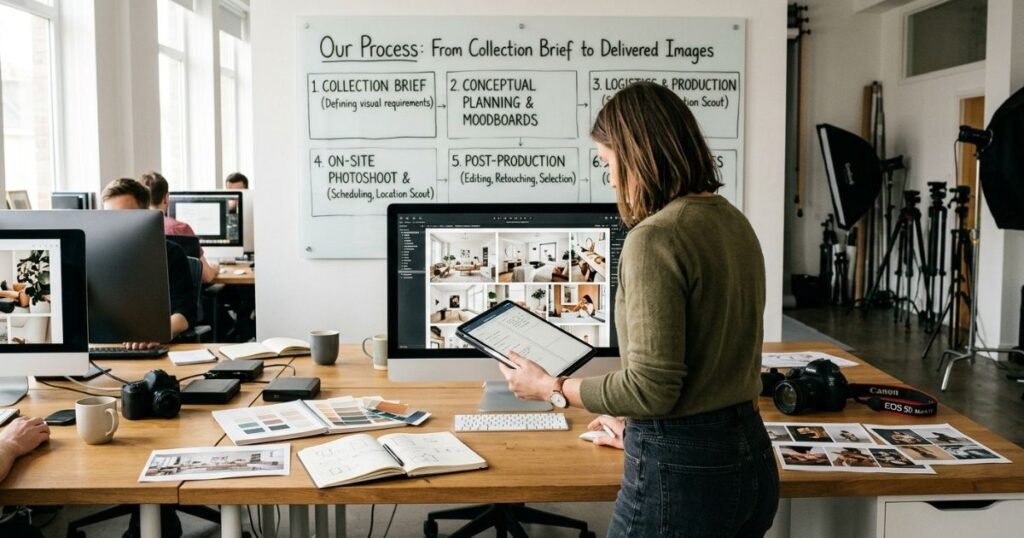
- Brief. Share your collection list, target platforms, and any brand guidelines. Shot angles, backgrounds, and styling approach get confirmed upfront.
- Setup. Studio or your location your choice. Macro lighting, backgrounds, and gold-tone calibration targets are set before a single frame is shot.
- Shoot. Each piece is photographed with macro lenses and focus-stacked for full depth-of-field sharpness, with gold-tone reference calibration from the first shot.
- Retouch & Deliver. Dust, fingerprints, and manufacturing marks are removed, gold tones corrected, and final files delivered via private gallery — typically within [48 hours / your stated turnaround].
Where We Shoot Studio and On-Location Across the UAE
For high-value collections, security matters as much as image quality. A mobile studio setup full lighting, backgrounds, lenses, and an editing workstation can travel directly to your showroom, vault, or boutique, so your inventory never leaves your sight.
Coverage typically spans Gold Souk Deira, DIFC, Dubai Design District (d3), Dubai Mall, Sharjah, and Abu Dhabi, with in-studio sessions available for smaller collections or single pieces.
Platform-Ready Files: Amazon, Shopify, Noon, and Instagram
Different platforms want different things from the same shoot, and it’s worth briefing your photographer on this upfront rather than re-shooting later.
- Amazon requires pure white-background hero images with strict crop and sizing compliance.
- Shopify favors consistent square or 4:5 product grids across a full catalog.
- Noon listings follow similar white-background rules to Amazon but with their own crop margins.
- Instagram and social benefit from a mix of white-background and lifestyle/model shots, cropped for feed and Stories.
A studio that delivers all four crop sets from a single shoot session saves you from paying for the same piece twice.
How to Choose a Jewelry Photography Service in the UAE
This is where most buyers get it wrong they compare portfolios without checking the fundamentals. Before you book, confirm:
- Is focus stacking included as standard, or charged as an add-on? (It should be standard this isn’t optional for jewelry.)
- Can they shoot at your location if your collection is high-value and shouldn’t leave the premises?
- Do they calibrate gold tone on-site, and can they explain how?
- What’s the actual turnaround time in writing, not “as soon as possible”?
- Do they provide platform-specific crops, or just one generic file size?
- Can you see a full image set from a past client not just curated portfolio highlights so you can judge consistency across dozens of SKUs, not just the best three shots?
This last point matters more than most buyers realize: a portfolio shows you their best work, not their average work. Ask to see a complete 20–30 piece set from one client shoot before committing a large collection.
Model vs. Product-Only Shoots Which Do You Need?
Product-only (white background or styled) photography is the backbone of any online store; it’s what customers scroll through and compare on price and detail. This is non-negotiable for e-commerce listings.
Model/lifestyle photography shows how a piece actually sits on a body scale, drapes, how a necklace falls, how a ring catches light on a hand. It’s most valuable for campaigns, social ads, and higher-margin pieces where customers are buying an experience, not just a spec sheet.
Most jewelry brands need both: product-only for the listing page, model shots for marketing. If the budget is tight, prioritize product-only first it directly affects conversion and returns then add model photography for your top-selling or highest-margin pieces.
Conclusion
Professional jewelry photography helps showcase the beauty, details, and quality of every piece. High-quality images build customer trust, strengthen your brand, and make your jewelry more appealing online. With the right lighting, styling, and professional techniques, stunning photos can attract more customers and increase sales.
FAQs
Do I need focus stacking for jewelry photography?
Yes, if you want the piece sharp from front to back. It should be included as standard, not an optional upgrade, on any professional jewelry shoot.
Can jewelry be photographed at my showroom instead of a studio?
Most professional jewelry photographers offer mobile studio setups for high-value collections, so pieces don’t need to leave your Gold Souk, DIFC, or showroom location.
How long does a jewelry photoshoot take?
A typical session covers a handful of pieces per hour depending on complexity; a collection of 30 pieces usually fits into a single day, with larger collections split across two.
What’s the difference between jewelry photography and standard product photography?
Jewelry photography requires macro lenses, focus stacking, and reflection management to handle small, highly detailed, reflective surfaces techniques standard product photography doesn’t typically use.
Do I need model photography, or is product-only enough?
Product-only white-background shots are essential for e-commerce listings; model photography is an addition for campaigns and social content, best prioritized for higher-margin pieces once your core listings are covered.