
Arabic copywriting services help businesses create persuasive, culturally relevant content that connects with Arabic-speaking audiences. High-quality Arabic copy improves brand trust, engagement, and conversions across websites, ads, emails, and social media. Choosing professional copywriting ensures your message is accurate, natural, and optimized for both readers and search engines.
What Is Arabic Copywriting, and Why It’s Not Just Translation?
Arabic copywriting is the process of creating original marketing content headlines, ads, web copy, product descriptions written directly in Arabic to persuade a specific audience, rather than converted from another language.
That distinction matters more than it sounds. Translation moves meaning. Copywriting moves people.
A translator’s job is accuracy. A copywriter’s job is persuasion. You can translate an English tagline perfectly and still watch it fall flat in Arabic, because grammar, rhythm, and cultural reference points don’t carry over one-to-one.
Here’s the quick breakdown:
| Service | Goal | Best for |
| Translation | Accurate meaning transfer | Legal documents, contracts, technical manuals |
| Transcreation | Recreate the emotional intent in a new language | Slogans, taglines, brand campaigns |
| Copywriting | Original persuasive writing in the target language | Web copy, ads, product pages, social content |
| Localization | Adapting content for a specific region’s norms | Pricing, imagery, date formats, dialect |
For most UAE marketing landing pages, ads, product descriptions you actually want copywriting or transcreation, not straight translation. A literal translation of “You’re not you when you’re hungry” would confuse an Arabic reader; a transcreation captures the same emotional punch with local phrasing instead.
Step 1 Choose Your Dialect: MSA vs. Gulf/Khaleeji
This is the decision most guides skip, and it’s the one that decides whether your copy sounds natural or stiff.
Modern Standard Arabic (MSA) is the formal, standardized Arabic used across all 22 Arab countries, the Arabic of news broadcasts, official documents, and most written media. The Gulf (Khaleeji) dialect is the spoken, conversational Arabic used day to day in the UAE and across the wider Gulf.
Here’s how to decide:
- Use MSA for: legal disclaimers, formal B2B content, government-facing copy, long-form website content meant to read as authoritative and neutral across the whole Arab world.
- Use Gulf dialect for: social media, ads, SMS/WhatsApp marketing, anything meant to feel warm, local, and conversational to a UAE audience specifically.
- Blend both when: you’re writing a website that needs to feel credible (MSA structure) but approachable (Gulf-inflected word choice and tone) this is the most common real-world approach for UAE brands.
Why this matters for conversions: copy that defaults to overly formal MSA in a casual ad context can read as cold or distant. Copies that use the wrong regional dialect (say, Egyptian phrasing in a UAE campaign) can read as slightly “off” to local readers, but it erodes trust.
Read More: Professional Copywriting Services in Dubai
Step 2 Design for Right-to-Left Reading (RTL)
Arabic script reads right-to-left, and that’s not just a text direction setting it changes how a layout is built from the ground up.
Key RTL considerations:
- Mirror the layout: not just the text. Navigation menus, icons (like arrows), and reading flow should all flip; a “next” arrow pointing right in English should point left in an Arabic layout.
- Line length and spacing: often need adjusting, since Arabic script is more connective and calligraphic than Latin script cramped line spacing hurts readability more in Arabic than in English.
- Numbers stay left-to-right: even within RTL Arabic text a common formatting mistake is flipping numerals along with the text.
- Test on mobile first: Most Gulf audiences read marketing content on phones, where RTL rendering bugs (misaligned buttons, broken CTAs) are most visible and most damaging to trust.
If your copywriter isn’t also flagging these formatting issues, you’re only getting half the job good Arabic copywriting services should catch RTL problems before they reach your live site or ad, not after.
Step 3 Write Headlines and Hooks That Work in Arabic
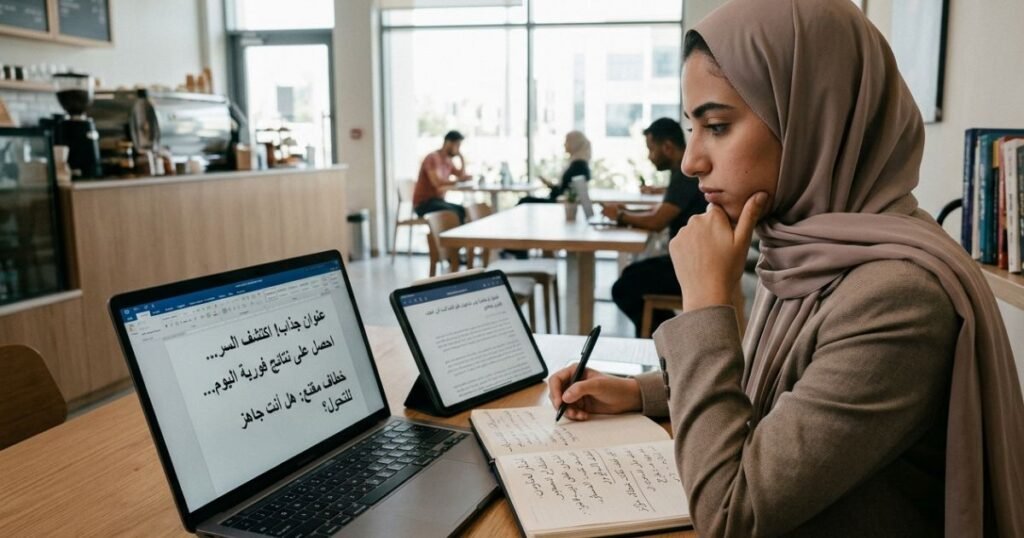
Good Arabic headlines follow different instincts than English ones, because Arabic carries more emotional and rhythmic weight per word.
What works:
- Short, punchy openers: Arabic script itself is denser visually, so a headline that’s concise in English can look cluttered when translated word-for-word into Arabic, trim it further than you think you need to.
- Lead with the benefit, not the feature: that holds true in any language, but it’s especially important in Arabic marketing copy, where feature-first openers tend to lose readers’ attention faster.
- Test dialect-specific phrasing: A headline that lands well in Egyptian Arabic won’t always land the same way in Gulf Arabic if you’re running UAE-specific campaigns, test with UAE-based reviewers, not just any Arabic speaker.
Step 4 Optimize for Arabic Search and AI Overviews
Arabic SEO isn’t just English SEO with translated keywords search behavior, keyword structure, and even AI Overview trigger patterns differ.
A few things to build into your content strategy:
- Arabic keyword research needs its own pass: Direct translations of English keywords often miss how Arabic speakers actually phrase searches; colloquial search terms can differ meaningfully from formal MSA equivalents.
- Structure for AI Overviews the same way you would in English: tight direct-answer openers, clear H2/H3 structure, and FAQ sections all still apply in Arabic content, since generative search engines parse structure, not just language.
- Right-to-left content still needs clean HTML markup: for search engines to correctly parse structure a technically sound Arabic page (proper dir=”rtl” tags, clean heading hierarchy) is table stakes before content quality even comes into play.
- E-E-A-T signals matter just as much in Arabic content: real author bylines, transparent sourcing, and accurate, current information (not stale stats) build the same trust signals search engines look for in any language.
Read More: SEO in Arabic Complete Guide to Arabic Search Optimization
When to Hire an Agency vs. a Freelance Copywriter
There’s no universal “right” cost for Arabic copywriting; it depends heavily on scope, dialect complexity, and whether you need ongoing content or a one-off project. Based on the visible UAE market, freelance Arabic copywriters typically sit at the lower end of the pricing spectrum, while established Dubai-based agencies with native-speaker teams and SEO integration price higher, often on a per-project or retainer basis rather than a flat per-word rate.
A quick decision framework:
| Choose… | If you need… |
| Freelance copywriter | A single project, tight budget, low complexity (product descriptions, social captions) |
| Boutique agency | Ongoing content, brand voice consistency, some SEO integration |
| Full-service agency | Multi-market campaigns, native-speaker teams across dialects, technical SEO + Arabic content combined |
A vetting checklist before you hire:
- Ask for native-speaker samples in the specific dialect you need (Gulf, not just “Arabic” generically).
- Request a short paid test piece before committing to a large project that reveals tone-matching ability fast.
- Confirm they handle RTL formatting, not just the raw text.
- Check if they can show real client outcomes (engagement, conversion lift) vague testimonials without specifics are a red flag.
- Ask directly: “Do you translate or do you write original Arabic copy?” the answer tells you a lot about their actual process.
Conclusion
Professional Arabic copywriting is more than simple translation; it creates content that speaks directly to your target audience. Well-written Arabic content improves user engagement, strengthens brand credibility, and increases conversions. Whether you need website copy, marketing campaigns, or SEO content, expert Arabic copywriting helps your business stand out in competitive markets. Investing in quality copy ensures your message is clear, persuasive, and culturally appropriate. The right words can turn visitors into loyal customers and support long-term business growth.
FAQs
Is Arabic copywriting the same as Arabic translation?
No. Translation focuses on accurately converting meaning between languages, while copywriting creates original, persuasive content written directly in Arabic. For marketing content, copywriting or transcreation almost always outperforms straight translation.
Should I use Modern Standard Arabic or Gulf dialect for UAE marketing?
It depends on context. Use MSA for formal, legal, or broad-reach content, and Gulf/Khaleeji dialect for social media, ads, and anything meant to feel local and conversational to UAE readers specifically.
Do Arabic copywriters need to be native speakers?
Ideally yes. Native speakers catch dialect nuance, cultural reference points, and tone issues that a fluent but non-native writer often misses, even with strong grammar skills.
How much does Arabic copywriting cost in the UAE?
Pricing varies widely by scope and provider type freelancers typically cost less than agencies, and pricing is usually project-based or retainer-based rather than a fixed per-word rate. Always request a scoped quote based on your specific content needs.
How do I check if an Arabic copywriter is actually good?
Request native-speaker writing samples in your target dialect, commission a small paid test piece, and ask directly whether they write original copy or primarily translate the answer reveals a lot about their process.