
Choosing the right Arabic SEO tools is essential for improving your website’s visibility in Arabic search results. These tools help you find relevant keywords, optimize Arabic content, track rankings, and analyze competitors. With the right SEO tools, businesses can attract more targeted traffic and achieve better online growth across the Middle East.
What Makes an SEO Tool Actually Work for Arabic?
An Arabic-ready SEO tool is one that correctly handles dialect variation, right-to-left (RTL) text rendering, and localized search volume data for individual Arabic-speaking countries, not just a tool that “supports” Arabic in its interface.
Here’s why that distinction matters:
- Dialect variation: The word for “car” is arabiya in Egypt and sayyara in Saudi Arabia. A tool that only suggests one variant will miss half your addressable audience.
- RTL rendering: Arabic text audits, technical crawlers, and content editors need to correctly display and process right-to-left text; plenty of Western-built tools still glitch here.
- Country-level search data: “Middle East” isn’t one search market. A keyword can have solid volume in the UAE and be dead in Egypt. Tools that only report regional MENA-wide volume fail to capture this.
Most competitor guides on this topic (2024-era listicles) skip this distinction entirely and just list tools that “have an Arabic interface.” That’s not the same as a tool built for Arabic SEO.
Best Arabic Keyword Research Tools
Keyword research is where dialect handling matters most. Here’s how the leading tools stack up.
| Tool | Arabic/Dialect Support | Free Tier? | Best For |
| Semrush | Strong country-level Arabic search volume, keyword variant discovery | No (paid, trial available) | Agencies managing multiple MENA client accounts |
| Ahrefs | Strong Keyword Explorer surfaces regional Arabic variants and difficulty scores | No (paid) | Competitive keyword gap analysis across MENA sites |
| Google Keyword Planner | Moderate works once you switch the interface language and target country to Arabic-speaking markets | Yes (with an active Google Ads account) | Budget-conscious teams doing basic volume checks |
Semrush and Ahrefs both let you set a specific target country (UAE, Saudi Arabia, Egypt) rather than lumping the whole region together; this is the single biggest reason they outperform free tools for dialect-sensitive research. Google Keyword Planner is a reasonable free starting point, but you’ll need to manually translate and test multiple dialect variants of the same core term, since it won’t surface them for you automatically.
Practical tip: run your core keyword through Keyword Planner in both the UAE and Egypt location settings. If the volume numbers differ significantly, you’ve likely found a dialect gap worth targeting separately.
Read More: Best SEO Company in Dubai Boost Traffic
Best Arabic Rank Tracking Tools
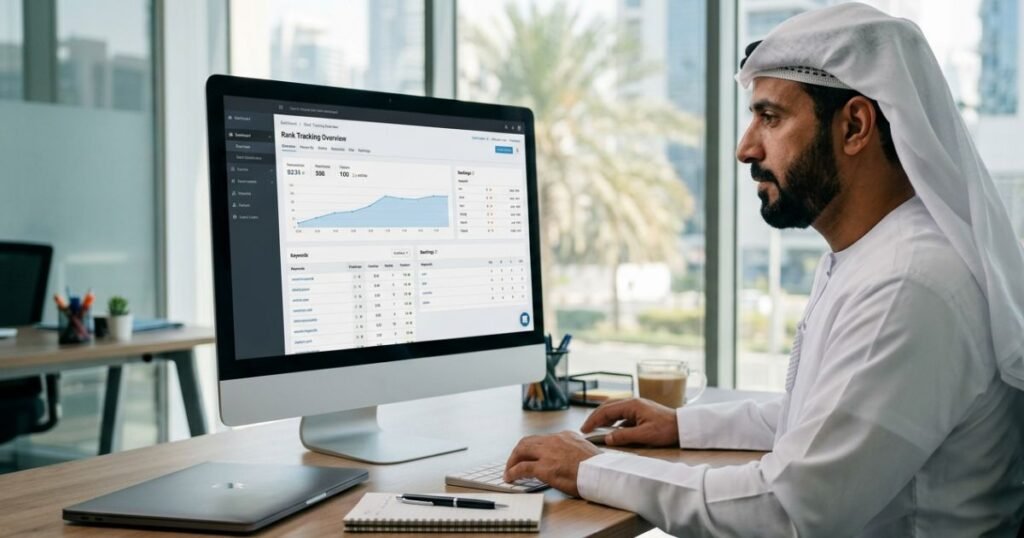
This is the category that almost no competitor content honestly addresses and it’s arguably the most important one.
Self-contained answer: Rank tracking for Arabic keywords is notoriously unreliable because most tools rely on data-center IP locations that don’t always reflect what a real searcher sees on the ground. Marketers who’ve worked across the region consistently report discrepancies between what tools report and what local search results actually show.
| Tool | Multi-Country Tracking | Notes |
| AWR Cloud (Advanced Web Ranking) | Yes location-specific tracking down to city level | Popular specifically because it lets you set granular location targeting, which helps close the accuracy gap |
| Semrush Position Tracking | Yes | Good for combining tracking with the same tool you use for keyword research |
| Manual spot-checks | N/A | Still recommended as a sanity check have someone physically located in the target country run the same search |
Original insight: don’t trust a single rank-tracking number for Arabic keywords. Cross-check your automated tool against a manual search from someone actually located in the target country at least once a month. This single habit catches more ranking discrepancies than switching tools ever will.
Read More: Arabic SEO Middle East Ranking Boost
Best Arabic Technical & On-Page SEO Tools
Technical SEO for Arabic sites has one recurring failure point: RTL rendering bugs that plugins and crawlers don’t always catch.
| Tool | RTL Handling | Best For |
| Rank Math | Good actively maintained RTL support, lightweight | Arabic WordPress sites wanting an all-in-one on-page plugin |
| Yoast SEO | Good long-standing RTL compatibility, simpler interface | Beginners who want guided, in-editor optimization advice |
| Google Search Console | N/A (not RTL-specific) but essential for catching Arabic sitemap and indexing issues | Every Arabic site, regardless of platform, as a free baseline |
Definition block: Google Search Console is a free Google tool that shows how your Arabic site performs in search impressions, clicks, average position, and technical errors like broken Arabic sitemaps or indexing failures.
RTL checklist to run through with any technical audit tool:
- Confirm the dir=”rtl” attribute is set correctly on Arabic pages.
- Check that the breadcrumb and navigation order haven’t flipped.
- Verify Arabic URLs (if used) don’t break when crawled inconsistent character encoding is a common, hard-to-spot cause of 404s.
- Confirm meta titles and descriptions aren’t being truncated in an odd way due to right-to-left rendering in the search snippet preview.
Read More: Complete SEO Audit 2026 Essential Checklist
Best Arabic Backlink Analysis Tools
| Tool | Strength for MENA Link Analysis |
| Ahrefs | Largest overall backlink index; strong for identifying MENA-region linking domains |
| Moz | Good Domain Authority scoring, useful for quick site comparisons |
| Majestic | Deep Trust Flow / Citation Flow metrics, useful for evaluating link quality in a market where spammy Arabic-language link networks are still common |
Direct answer: For most Arabic SEO backlink work, Ahrefs gives the broadest data coverage, while Majestic’s Trust Flow metric is particularly useful for filtering out the low-quality Arabic link networks that were common in the region’s earlier, spammier SEO era.
Best Local SEO Tools for Arabic Businesses in the UAE
If you’re targeting local customers in Dubai, Abu Dhabi, or elsewhere in the UAE, your toolkit needs a local-search layer:
- Google Business Profile: set your business name, description, and posts in Arabic in addition to English; bilingual profiles consistently perform better for mixed-language local searches in the UAE.
- Bing Places: smaller market share, but worth claiming since Bing Arabic search still carries meaningful traffic in some GCC segments.
Read More: SEO in Arabic Complete Guide
How Do I Choose the Right Arabic SEO Tool for My Budget?
This is the decision most guides skip here’s a practical framework based on team size and goals:
- Solo marketer or small business: Google Keyword Planner + Google Search Console + Rank Math. All free or near-free, covers the essentials.
- Growing brand with a dedicated marketer: Add Semrush or Ahrefs (pick one, not both they overlap heavily) plus AWR Cloud for tracking.
- Agency managing multiple MENA clients: Run both Semrush and Ahrefs for cross-verification, add Majestic for link-quality auditing, and budget for AWR Cloud’s multi-location tracking tiers.
Flag for your input: if your brand already has usage data from any of these tools, swap in your own findings here real client results will strengthen this section far more than general guidance.
Read More: Arabic SEO Checklist for UAE Businesses
Conclusion
Arabic SEO success depends on using tools that understand the language, search behavior, and regional trends. The best Arabic SEO tools simplify keyword research, content optimization, technical SEO, and performance tracking. Whether you run a business, blog, or eCommerce store, investing in the right tools can improve your rankings and increase organic traffic. Combine these tools with high-quality Arabic content and a consistent SEO strategy for long-term results. Regularly monitor your website’s performance and update your content to stay ahead of competitors. With the right approach, you can build a stronger online presence and reach more Arabic-speaking customers.
FAQs
What is the best SEO tool for Arabic websites?
There’s no single best tool; most Arabic SEO practitioners combine Semrush or Ahrefs for research, Rank Math or Yoast for on-page fixes, and AWR Cloud for rank tracking, since each tool covers a different weak spot in Arabic SEO.
Does Google Keyword Planner work for Arabic keywords?
Yes, once you switch your account’s interface language and target location to an Arabic-speaking country. It won’t automatically surface dialect variants, so you’ll need to manually test alternate spellings.
Can I use English SEO tools for Arabic sites?
Most major tools (Semrush, Ahrefs, Moz) technically work on Arabic sites, but their usefulness depends on whether they let you set country-specific targeting and correctly render RTL text in reports.
What is the best free Arabic keyword research tool?
Google Keyword Planner is the most accessible free option, especially when paired with manual dialect testing across different country settings.
Why is Arabic keyword rank tracking often inaccurate?
Rank tracking tools generally rely on data-center locations rather than real searcher locations, which can produce ranking numbers that don’t match what an actual person in that country sees. Tools with granular, city-level location targeting (like AWR Cloud) reduce but don’t eliminate this gap.
Do I need separate tools for each GCC country?
Not separate tools, but separate settings within the same tools. Set individual country targeting for keyword research and rank tracking, rather than treating “Middle East” as a single market.