
A Food Packaging Design Agency is a specialized creative service that designs attractive, functional, and compliant packaging for food products, helping brands stand out on shelves and appeal to customers while clearly conveying important information like ingredients and nutrition; it typically offers services such as packaging and label design, branding, market research, and print-ready artwork to ensure both visual impact and industry compliance.
What a Food Packaging Design Agency Actually Is (And Isn’t)
A food packaging design agency is a specialist studio that handles the full visual and structural design of food product packaging from concept and brand identity through to print-ready dieline files, label compliance, and material guidance. The key word is specialist.
A generalist graphic designer can make something that looks good on screen
A food packaging agency makes something that survives the printer, survives the shelf, and survives the consumer’s decision in 7 seconds.
According to a global consumer survey by Ipsos, 72% of consumers say packaging design plays a direct role in their purchasing decisions. That number has been cited consistently across packaging industry research through 2024 and it understates the pressure on food brands specifically, where buying decisions happen in under 10 seconds at retail.
The 5 Mistakes Food Brands Make When Hiring a Packaging Agency
Founders who’ve gone through this process once almost always say the same thing when they look back: the red flags were there. They just didn’t know what to look for.
Mistake 1: Treating packaging like logo design
Packaging involves structural dielines, substrate-specific color profiles (CMYK vs. Pantone), bleed and safe zones, print vendor specs, and in food specifically — legally required label elements. A logo designer doesn’t know any of this. Neither does Canva, which is why brands that design their packaging in Canva eventually discover the files aren’t usable for professional print production.
Mistake 2: Judging purely by aesthetics
A stunning portfolio proves taste. It doesn’t prove the agency knows how warm-colored packaging increases purchase intent for indulgent snacks (research from Frontiers in Psychology, 2026, shows this effect is measurable and replicable), or that green packaging can actually suppress purchase intent for high-fat foods. Food packaging psychology is a real discipline and most portfolio pages don’t show it.
Mistake 3: Skipping the question about file deliverables
Ask every agency you consider: What do we receive at the end of the project, and in what formats? You want layered source files, print-ready PDFs, dieline templates, and ideally a packaging style guide. If the answer is vague, walk away.
Mistake 4: Assuming review platforms tell the whole story
Directories like Clutch.co rank agencies by review score and client volume. That’s useful for filtering obvious bad actors. What Clutch doesn’t tell you: whether an agency has ever navigated FDA Nutrition Facts panel requirements, whether they understand FSMA label compliance for food contact materials, or whether their designers know how flexible packaging behaves differently in print than rigid cartons. Review scores don’t capture domain expertise.
Mistake 5: Not asking about their print vendor relationships
The best food packaging agencies have existing relationships with food-grade packaging printers. This matters more than most clients realize especially for first runs, short runs, and specialty materials like matte laminates or biodegradable substrates.
What to Look for in a Food Packaging Design Agency
Here’s what separates a food specialist from a generalist with a few food clients:
Food-specific portfolio depth
Food packaging across multiple categories (beverages, dry goods, refrigerated, DTC), multiple materials (flexible, rigid, paper-based), and multiple markets (retail, foodservice, e-commerce).
Process transparency
The agency should be able to explain what happens between your first brief and your final file. A real food packaging process includes: brand strategy, structural concepting, dieline selection, visual design, typography with label hierarchy, print proofing, and file handoff. If they skip straight to “here’s what our designs look like,” that’s a process gap.
Label compliance awareness
In the US, the FDA mandates specific formatting for Nutrition Facts panels, allergen declarations, and net quantity of contents. In the EU, the requirements differ. A food packaging agency should at minimum flag these requirements and work with your compliance team — they’re not legal advisors, but they shouldn’t be ignorant of these frameworks either.
Material and sustainability knowledge
The global eco-friendly food packaging market reached $199.99 billion in 2024 and is on track to nearly double by 2034, according to Towards Packaging (2026). If your agency can’t discuss FSC-certified paperboard, PCR plastic content, or compostable substrate options, they’re behind the curve and behind what your retail buyers are increasingly asking for.
Quick Comparison: Agency Types for Food Packaging
| Option | Best For | Key Benefit | Limitation |
| Food packaging specialist agency | Brands launching in retail or scaling | Deep category knowledge, print-ready files | Higher cost, longer timelines |
| Full-service branding agency | Brands needing full identity + packaging | One vendor for all brand assets | May lack food-specific print expertise |
| Freelance packaging designer | Small budgets, simple SKUs | Flexible, lower cost | Variable quality, no structural support |
| Fiverr / 99designs | Mood boarding only | Fast, cheap ideation | Not suitable for production-ready deliverables |
The Sustainable Packaging Problem Most Agencies Ignore
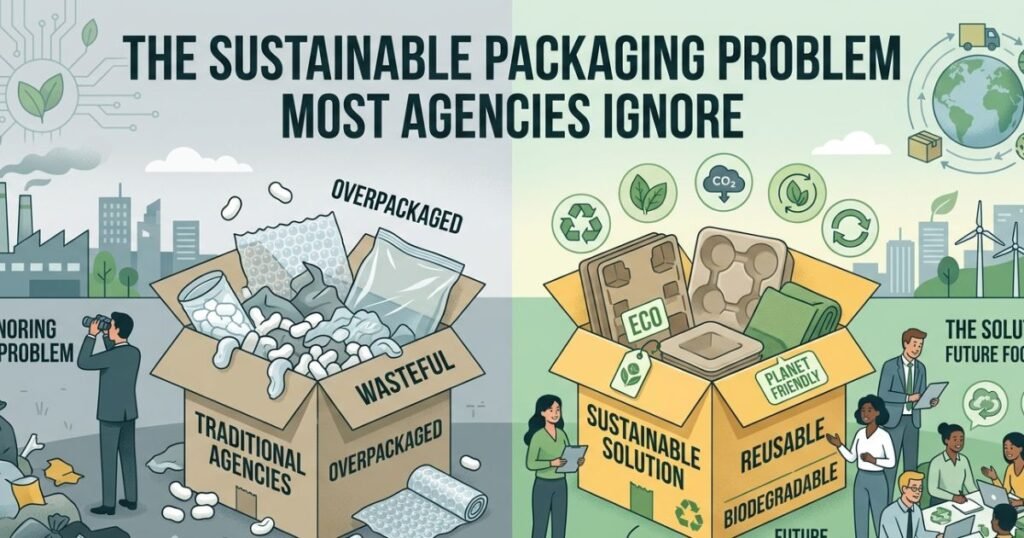
Brands know they need to care. Retailers are starting to require it. And 90% of Gen-Z consumers have said they’re willing to pay more for products with sustainable packaging, according to research cited by Business Dasher (2024). But what most agencies miss is that sustainable packaging has material-specific design constraints that change the visual output.
Compostable substrates behave differently on press
Recycled paperboard has a different surface texture that affects how inks sit. Some eco-friendly laminates don’t support the same level of high-gloss finishing. If your packaging agency recommends a sustainable material without knowing these production realities, your final result won’t match the proof.
Companies like Amcor which has worked with brands ranging from Cadbury to MadeGood to Stonyfield Organic have been pushing food packaging production toward recyclable and bio-based material systems since at least 2024. For food brands, this creates a real challenge: your packaging agency needs to either understand these material constraints, or have print partners who do.
Generalist vs. Specialist: The Honest Version
Some experts argue that a generalist agency with strong creative chops can handle food packaging just as well as a specialist. That’s valid for brands whose packaging is primarily DTC, digital-first, or where the visual brand story is the entire job.
But if you’re going to retail shelves, scaling into foodservice, or operating in any regulated food category, the argument breaks down fast. The structural knowledge, print production relationships, and label compliance awareness that food specialists carry aren’t things you can Google your way through mid-project.
I’ve seen conflicting opinions on this some brand consultants insist that category experience is overrated and creative strategy is what actually moves product. My read: both matter, and the risk of choosing pure creative without category knowledge is higher than the reverse, especially for first-time food founders.
Conclusion
A professional food packaging design agency plays a vital role in shaping how customers perceive a brand. By combining creativity, strategy, and market understanding, it delivers packaging that not only looks attractive but also communicates quality and trust. Strong packaging design helps products stand out in a crowded market, increases customer engagement, and ultimately drives higher sales and long-term brand success.
FAQs
What’s the best way to find a food packaging design agency?
Search for agencies with verified food-specific portfolio work that went to print — not just concepts. Check Dieline.com for trend-literate studios and ask directly about their print vendor relationships and label compliance process. Clutch.co reviews are a useful filter but don’t capture food expertise.
How do I know if a packaging agency specializes in food?
Ask to see packaging work that actually went to retail print, across multiple food categories. A specialist will also be able to discuss dieline formats, FDA label requirements, and material substrates without being prompted.
Should I hire a freelancer or an agency for food packaging?
Freelancers work well for simple DTC SKUs with low print complexity. For retail-ready, multi-SKU launches or any product requiring label compliance, a specialist agency is the safer investment the cost of reprinting wrong files exceeds the agency premium.
Why does food packaging design cost more than regular graphic design?
Food packaging involves structural dielines, substrate-specific color management, print vendor coordination, regulatory label requirements, and production-ready file preparation none of which are part of standard graphic design scope.
When should I start the packaging design process?
Start at least 12–16 weeks before your intended launch date. Retail buyers often want final packaging before purchase orders, and print production for food-grade packaging typically takes 4–8 weeks after final file approval.